
Evidence Before the Kids-Safe Claim: Documents From a Guangzhou OEM
A kids-safe claim on pack is a documentation decision long before it is a marketing one. The brand has to be able to show what is in the product, how it was assessed, how it was made and who verified it, and each of those answers comes from a different document issued by a different party at a different moment. Working backwards from the claim to the document chain is the only reliable way to avoid discovering a gap after the container has shipped.
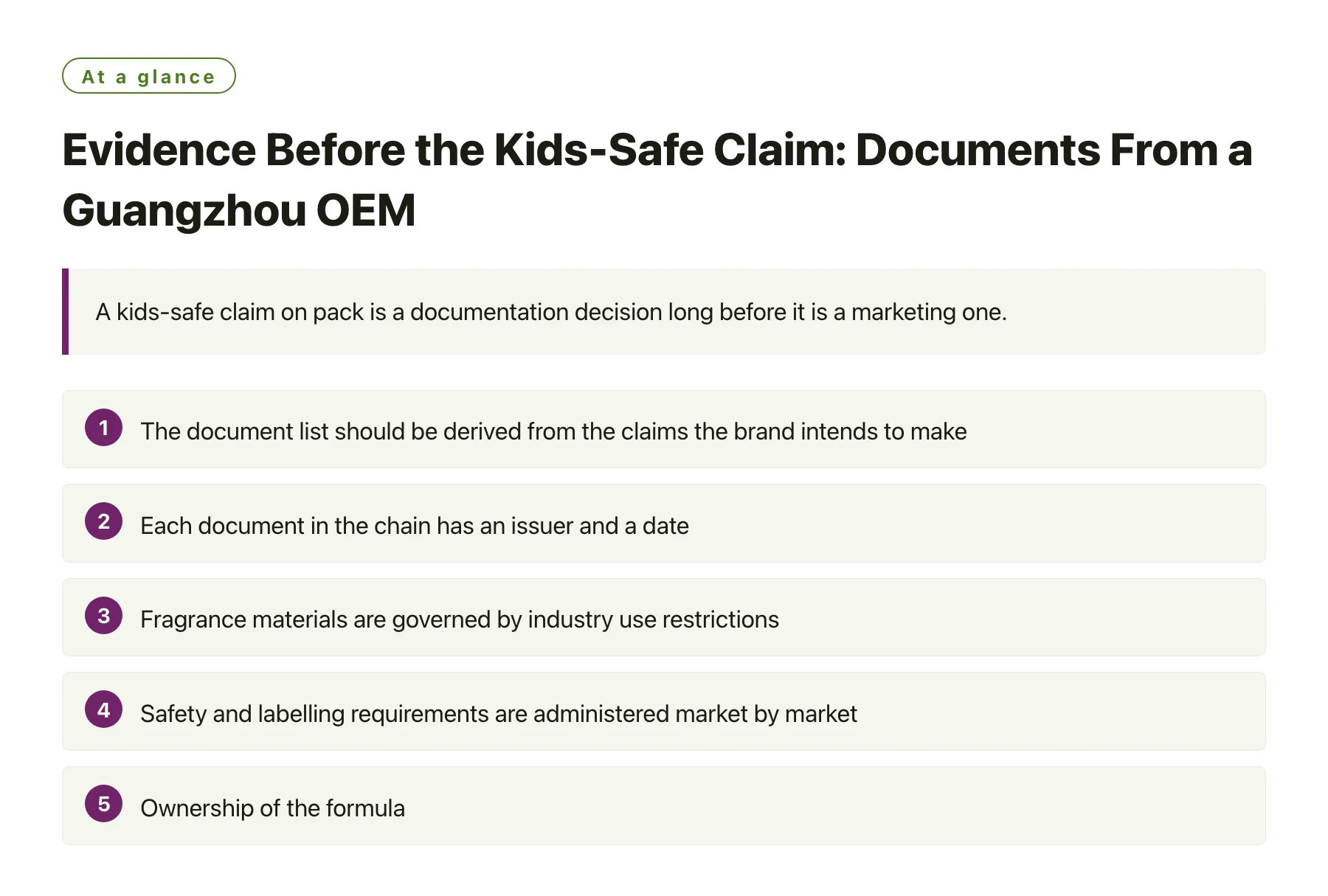
Key takeaways
- The document list should be derived from the claims the brand intends to make, not copied from a previous project.
- Each document in the chain has an issuer and a date, and a document without a named issuer is not evidence.
- Fragrance materials are governed by industry use restrictions, so the restricted-material statement has to be checked against the finished formula.
- Safety and labelling requirements are administered market by market, so the destination has to be named before the documentation set can be finalised.
- Ownership of the formula, the pack design and the supporting records belongs in the agreement from the start, not in a discussion after the first order.
Manufacturers in Guangzhou are used to documentation requests, because export work generates them constantly. The difficulty is rarely the factory's willingness to provide paperwork; it is the brand's ability to specify which paperwork, for which market, to support which sentence on the pack.
That specification work is the brand's. A factory can produce a certificate of analysis for a batch; it cannot decide whether the brand is entitled to call a product gentle, or whether a claim about being suitable for family use is defensible in the market where the product will be sold.
This walkthrough sets out the document chain in the order it is actually assembled, and marks the points where a kids-safe positioning adds a step.
Start from the claim, not from a document list
Brands often arrive with a list of documents copied from a previous launch and ask the factory to supply them. That approach produces a folder of paper and no certainty, because the list was assembled for a different product, a different market or a different set of claims.
Working forwards from the claim is more reliable. Write down every statement the pack, the listing and the marketing copy will make, then ask for each one: what would demonstrate this? A claim about ingredient sourcing, a claim about product safety, and a claim about manufacturing standards each require a different kind of evidence from a different issuer.
The claims that need the most support
Positioning around children and families tends to generate claims about what the product avoids and who assessed it. Claims of that kind are the easiest to write and the hardest to substantiate, so they should be listed and assigned evidence before the artwork is designed rather than after.
Why the market has to be named first
Cosmetics rules are administered nationally even where the underlying principles are shared, so the required safety assessment, the notification route and the labelling details differ by destination [1]. A brand selling into more than one market needs to decide whether it is assembling one documentation set per market or looking for the intersection that satisfies all of them, and that decision changes the work involved.
The document chain for a kids-safe order, in sequence
| Document | Usually issued by | Needed by | What it demonstrates |
|---|---|---|---|
| Formula and ingredient declaration | The factory's development or regulatory team | Before the safety assessment | Exactly which materials are in the finished product, at what level |
| Restricted-material statement | The fragrance house, against its formula | Before formula approval | That fragrance use restrictions have been checked for this product category [2] |
| Safety assessment | A qualified assessor, often external | Before notification and labelling | That the finished product has been assessed for its intended use |
| Allergen declaration list | Derived from the formula by the regulatory team | Before artwork is finalised | Which fragrance allergens must appear on the label, and at what level |
| Stability and compatibility report | The factory's laboratory | Before the pack and formula are locked | That the product holds up in its container over the intended shelf life |
| Manufacturing standards evidence | The factory, with certificates from its certification bodies | At supplier qualification | Which quality and environmental systems the site operates and who audited them |
| Batch record and certificate of analysis | The factory's quality team | At delivery | That the specific batch was made to the approved specification |
Read the second column as a responsibility map. Every document should have an issuer outside the brand, and every issuer should be named in the agreement. A document produced by the brand to describe the product is a statement, not evidence.
Where markets diverge, and why it matters to a small brand
Two markets can both regulate cosmetic safety seriously and still require different paperwork. Naming and disclosure obligations vary, the route by which a product is placed on the market varies, and the detail expected on a label varies [3]. For a small brand, the practical consequence is that a documentation set built for one market rarely transfers without amendment.
The sensible sequence for a first launch is to assemble the full set for the market where the product will actually sell, then treat additional markets as an extension project with its own timeline. Trying to satisfy several markets at once on a first order usually delays the first one.
Naming and identification across markets
Ingredient naming is a common source of delay, because a declaration list reviewed against one reference may not match the naming used by another authority. European ingredient naming conventions are widely used as a common reference, so it is worth asking the factory to state which convention its declaration follows and to keep that stated convention consistent across every version of the artwork.
What a Guangzhou factory can reasonably provide
A well-established export manufacturer will have a standard document pack and a person who owns it. Xuelei, the company behind the factory, states that it holds ISO 22716 for cosmetics good manufacturing practice alongside GMPC, ISO 9001, ISO 14001 and ISO 45001, and that it meets HALAL requirements, which gives a brand something concrete to verify rather than a general assurance the company behind the factory. Certificates are worth checking against the issuing body and the scope of the site, since a group-level certificate does not automatically cover a specific production line.
Version control is where documentation projects quietly fail. A formula is amended, a label is re-proofed, a stability report is superseded - and the folder still contains the earlier version with nothing marking it as obsolete. Use one document register with a version number, an issue date and the name of the person who approved each item, and require superseded versions to be withdrawn rather than filed alongside current ones. When a retail buyer asks for the safety assessment, you want to hand over the version that matches the formula you actually produced.
What to agree about ownership and use
Documentation and intellectual property overlap, and the overlap is where brand-side value sits. The formula, the pack design, the artwork and the test reports all have an owner, and the default position is not always the brand.
Intellectual property protection is organised through national registrations and international treaties, which is why ownership questions have to be answered by reference to where the rights are filed rather than to where the product is made [4]. A formula that is not registered as a trade secret in the agreement, or a pack design that is not protected, is difficult to recover once the relationship ends.
Write the ownership position into the order
The agreement should state who owns the formula, whether exclusivity applies and for how long, who owns the moulds and artwork, and what records the factory retains and for how long after the last shipment. These terms are settled cheaply at the start and expensively later.
Match the documentation to the route you bought
A white label or library route carries different ownership than a developed formula, so the documents and the commercial terms should describe the same thing. If the brand is buying a factory for your own perfume label, the exclusivity position is central to the value of the project and belongs in writing before sampling a factory for your own perfume label.
Then check the production route
Finally, confirm that the site that will produce the order is the site whose certificates and records you reviewed. OEM perfume production in Guangzhou often runs across more than one workshop or partner site, and the documentation set should name the site rather than the group OEM perfume production in Guangzhou.
Sources
- European Commission: Cosmetics in the EU —— The European Commission's overview of EU cosmetics rules, including the responsible person, product information file and safety report requirements.
- IFRA Standards Library (International Fragrance Association) —— The IFRA Standards Library lists the restrictions the fragrance industry applies to individual fragrance ingredients, based on safety assessments; it is the reference point for compliant fragrance formulation.
- Health Canada: Cosmetic Safety —— Health Canada's cosmetics pages, covering cosmetic notification, the ingredient hotlist and safety requirements for cosmetics sold in Canada.
- WIPO — World Intellectual Property Organization —— The UN agency for intellectual property; resources on industrial design and patent protection relevant to product and packaging design.
Frequently asked questions
What documents should a perfume OEM in China provide as standard?
At minimum a formula and ingredient declaration, a restricted-material statement, a stability report, manufacturing standards evidence and a batch certificate of analysis at delivery. The safety assessment and allergen declaration are usually arranged with the brand's market in mind and should be confirmed rather than assumed.
Who is responsible for the safety assessment?
For products placed on the market, responsibility rests with the party placing the product on the market, which in practice means the brand. Factories frequently arrange the assessment through a qualified assessor, but the brand should confirm who commissions it, who holds it and whether it is in the quoted price.
Can one documentation set cover several markets?
Sometimes, if the markets' requirements overlap and the labels can carry the combined information. It is usually cheaper for a first launch to build the set for one market, sell there, and extend the file later rather than trying to satisfy several authorities at once.
How do I know a certificate actually covers my production?
Check the certificate against the issuing body, the certified scope and the site named on it. Ask whether the specific line that will produce your order falls inside that scope, and ask for the site name in writing.
When should ownership of the formula be settled?
Before the first order, and ideally before sampling. Ownership, exclusivity duration and the treatment of moulds, artwork and records are commercial terms that are cheap to agree at the start and difficult to renegotiate once production is running.
Klar for å bli kjent med naboene dine?
Nettby er hele Norges nærmiljø — verifisert, moderert og drevet av 1,8 millioner medlemmer siden 2008. Gratis å starte, lokalt forankret.